In dusty excavation reports and antiquarian volumes, a lawyer-turned-archaeologist has uncovered evidence that upends the known history of human gambling.
The findings, published Thursday in the journal American Antiquity, suggest that Native Americans had dice and games of probability 12,000 years ago. That’s thousands of years earlier than the practice is thought to have existed anywhere in the Old World — Europe, Africa or Asia.
The study says such activities, based on the concepts of chance, randomness and probability, were first developed in the present-day Southwestern U.S. — not in Mesopotamia or by other ancient cultures.
“We see it right in North America, beginning 12,000 years ago, people really starting to engage with some really complex kinds of intellectual concepts that aren’t grappled with in the Old World until many thousands of years later,” said Robert Madden, a doctoral student at Colorado State University, who is the study’s author. “These concepts end up being foundational to our modern scientific understanding, our modern economy.”
Madden, 62, was a trial lawyer for about 25 years before he began pursuing archaeology. He spent about three years combing through old archaeological site reports to build the timeline in his study. Before this, no one in the field had established criteria for what should be included in the archaeological record of dice.
“I did not dig up any new Native American dice,” he said. “It just needed somebody to come along and pull it together.”
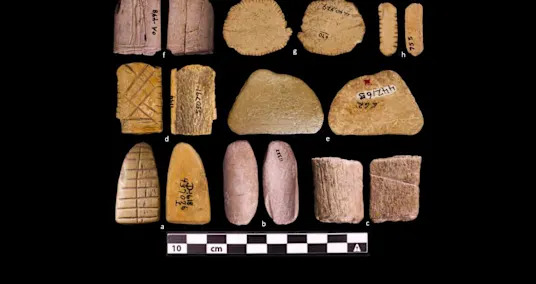
Researchers have studied Native Americans’ use of dice for more than a century. The dice are almost always two-sided and made of bone or wood. They’re carefully shaped to produce random outcomes and marked or colored to indicate different sides.

Previous studies had traced the history of such items back around 2,000 years. But Madden found evidence of dice stretching thousands of years longer, to the end of the last Ice Age. Dice had been found in the first half of the 20th century at several archaeological sites once occupied by the Folsom culture. The sites are between 12,255 and 12,845 years old.
The new timeline shows continuous use of dice in the present-day Southwestern U.S.
“We can just see them showing up all throughout this region, all through this period of time, from 12,000 years all the way up to European contact, through European contact all the way up to today,” Madden said.
Native American oral histories refer to gambling frequently, said Robert Wiener, a postdoctoral fellow at Dartmouth University who has studied gambling and religion at Chaco Canyon in New Mexico, an ancient Puebloan center.
“At least in the Southwest, the stories about gambling often convey that it’s something that can easily get out of control. At the same time, there’s a bunch of cultural practices where gambling is something we might call religious, or it’s like a social event that brings people together,” Wiener said.
In some stories, including one from the Zuni people, deities gamble, he added.
No prehistoric dice have ever been discovered in the eastern part of North America. It’s not clear why; the reason could simply be that materials are less likely to be preserved there, which biases the archaeological record.
Madden thinks prehistoric Native American groups in the west often traveled and used games as a social mechanism to fuel trade and exchange information. He said written accounts of Native American dice games date to the 1600s. The records, many from eastern North America, suggest the games were fast-paced, often played among unfamiliar groups.
“These tended to be very social affairs, very raucous affairs,” he said. “You tend to have a large crowd be gathered around the game and all kinds of side bets going on during the contest.”
No written records document prehistoric dice games, however, so many questions remain open.
“Were they actually calculating the probabilities? I don’t know,” Madden said.
Nonetheless, he said, his research offers evidence that Native Americans were doing complex counting and were likely to have been the first humans to contemplate concepts like the law of large numbers, a mathematics concept that describes how a random sample will trend toward an equal distribution over time.
“What we’re really looking at here is an intellectual accomplishment,” he said.
The dice evidence is about 6,000 years older than the equivalent in Bronze Age societies in Africa, Europe, and Asia.
“It’s an incredibly exciting finding, because for so long, the intellectual aspects of native Native American cultures have really been sidelined, if not consciously suppressed by colonial powers,” Wiener said.
“Dice games of chance are one of the most visceral, embodied, direct and sort of emotional means in which people can engage with those questions” of probability, he added.

Madden studied archaeology as an undergraduate, then spent 25 years as a trial lawyer. As a partner at the Houston law firm Gibbs & Bruns, he focused on cases that stemmed from the 2008 financial crisis.
Madden left legal practice in 2017 and started independent research on the Olmec civilization, an early Mesoamerican population, before he began a master’s program in archaeology — his “original love” — in 2022.
The multiyear investigations he conducted as a lawyer, with “millions and millions of pages of documents,” were perfect training for sorting through the massive archaeological record, Madden said.
Wiener said: “He just sort of took the time to systematically go through lots and lots of reports. It often takes an outside force, right, to see things in a new light.”
This article was originally published on NBCNews.com
LATEST POSTS
- 1
 Instructions to Pick the Ideal Pre-assembled Home for Your Necessities
 - 2Sun storms are powered by a magnetic engine 16 Earths deep, study finds
- 3Earth's newfound 'episodic-squishy lid' may guide our search for habitable worlds
- 4Israel reports first missile fire from Yemen since start of Iran war
- 5Strengthening through Wellness: Individual Preparation Achievement





- Surveys of 6 Hot Savvy Beds
- A company is trying to unlock a key to aging, in a long-overlooked body part
- Rick Steves Doesn't Want You Overlooking This Food Spot While In France
- It Shouldn’t Be Here: Rescuers Race to Save Whale Stranded in Rare Spot
- When is MLK Day? Plus, the dates of when other federal holidays land in 2026.
- How did humans evolve, and will we evolve more?
- Vote in favor of your Favored Kind of Scarf
- The most effective method to Decide the Best Auto Crash Attorney for Your Lawful Necessities
- Medical team successfully delivers baby and removes massive tumor